
Cooperative Ownership Explained
How cooperative and collective ownership structures let a distributed diaspora hold land together — fairly and durably.
Multimodal learning
Listen to Story
Read, listen, or move between both. Narration never starts automatically, and the written lesson remains available throughout.
Narration support unavailable
This browser does not currently expose a read-aloud voice. You can still use the complete written lesson, and a human-recorded narration option can be added when available.
No single person carries the land alone.
For diaspora communities trying to build something lasting, that truth matters. A return movement cannot depend entirely on one wealthy founder, one family, or one central figure holding everything in their own name. That creates fragility. If that person dies, changes direction, experiences financial trouble, or becomes a bottleneck, the entire project can weaken.
Cooperative ownership offers another path.
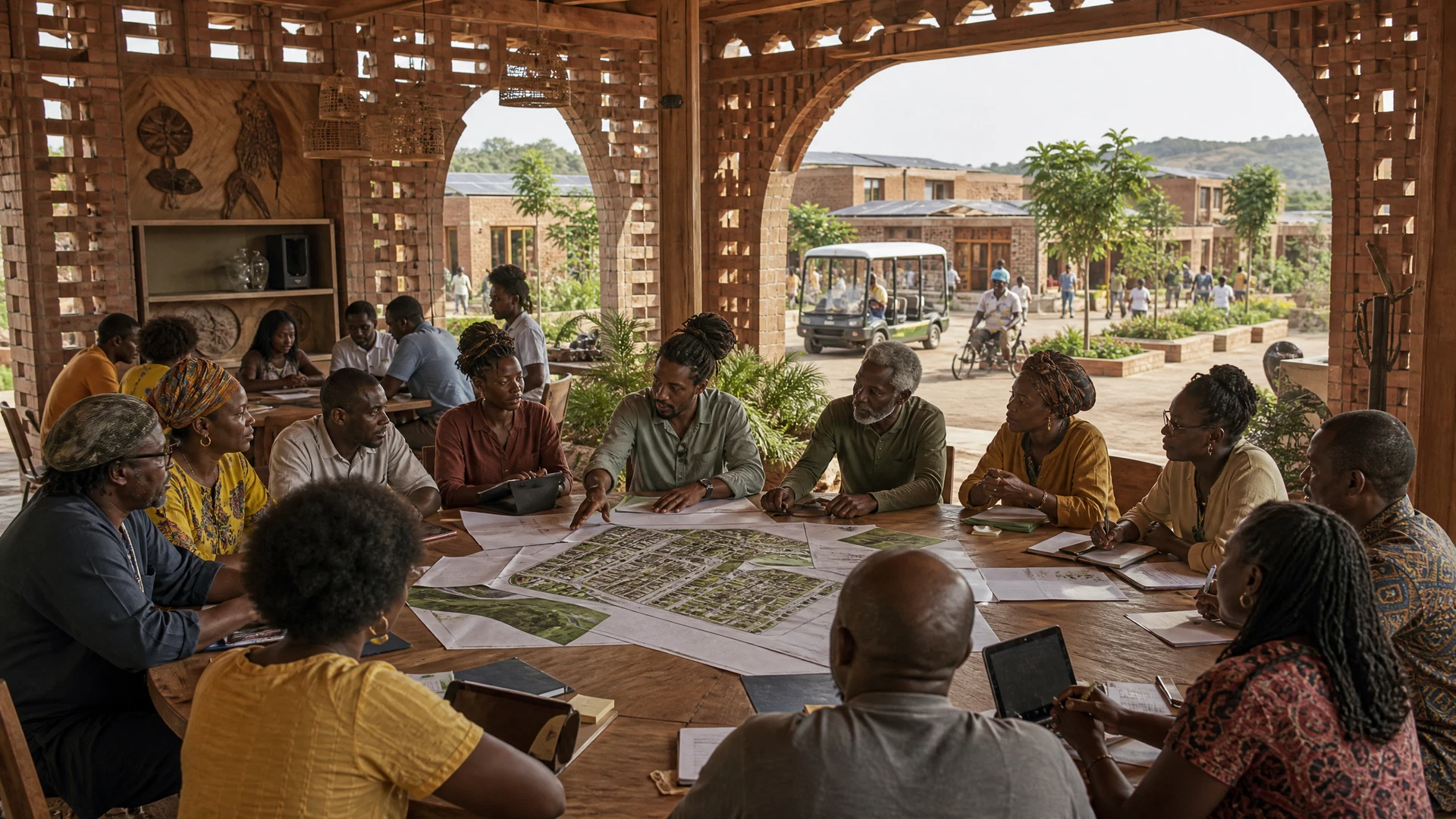
It allows a community to hold land, resources, responsibilities, and benefits together through a shared structure. Instead of concentrating power in one pair of hands, it distributes stewardship across many people. For a scattered diaspora—people living across different cities, states, and countries—that can be one of the most powerful tools available.
Cooperative ownership is not simply about “sharing.” It is about creating a durable legal and governance framework so a community can act collectively without descending into confusion, conflict, or exploitation.
Why cooperative ownership matters
Most diaspora people are not returning with unlimited capital.
Some may be able to contribute significant funds. Others may bring skills, labor, networks, equipment, or knowledge. Some may be ready to relocate full-time. Others may remain abroad but still want to invest, participate, and help build. A cooperative model recognizes that community-building does not happen through money alone.
It creates a structure where participation can be organized in a fairer way.
Instead of land being owned by whichever individual had the largest bank account at the beginning, a cooperative model can make it possible for many people to become stakeholders in a shared mission. That matters because the goal is not just to build property. The goal is to build continuity, belonging, and a system that can outlast individual personalities.
A cooperative structure also helps answer a hard but necessary question:
How do we keep a collective project collective?
Without a structure, people may begin with trust and goodwill, but eventually disagreement emerges. Who gets to decide how the land is used? Who can live there? Who benefits if the land becomes more valuable? Who is responsible for maintenance, taxes, infrastructure, or debt? What happens if someone wants to leave and get their contribution back?
A cooperative framework does not eliminate those questions. It gives the community a way to answer them in advance.
What cooperative ownership is
At its core, cooperative ownership means a group of people collectively owns or controls an asset and governs it according to agreed rules.
Those rules may vary depending on the structure, the country, and the community’s goals. But the principle remains the same: the land or enterprise is not controlled solely for private gain by one owner. It is held in a way that reflects the shared interests of a membership body.
This can take many forms. In some cases, members own shares in a cooperative entity. In others, the land is held by a trust, association, nonprofit, company limited by guarantee, or another legal body whose purpose is community benefit. In still other models, members may not directly “own” the land as individuals, but they hold defined rights to live on it, use it, build on it, inherit occupancy rights, or participate in governance.
The exact legal structure matters. But the deeper question is always this:
Does the structure protect the community’s long-term mission, or does it quietly allow the project to become somebody’s private estate?
Common structures
1. Cooperatives
In a classic cooperative model, members share ownership and governance. Often, each member has one vote regardless of how much money they contributed. That principle matters because it prevents wealthy participants from automatically controlling the entire direction of the project.
A cooperative can be useful when the aim is broad participation, democratic decision-making, and clear membership rules. Members may contribute capital, annual dues, labor, or service. The cooperative may hold land directly, run businesses on the land, manage shared services, or coordinate housing and agricultural activity.
The strength of a cooperative is that it ties ownership to participation, not just money.
The challenge is that cooperatives require strong bylaws, careful membership systems, bookkeeping, and a culture of accountability. A poorly run cooperative can become slow, political, or disorganized. Democracy alone is not enough. It must be paired with operational clarity.
2. Community land trust–style models
A land trust approach separates stewardship of land from purely private ownership of buildings or improvements.
In this kind of structure, the land is held by an entity for long-term collective benefit. Individual families or members may still have strong rights to use land, occupy homes, farm plots, or transfer certain interests—but the land itself is protected from speculation and permanent fragmentation.
This model can be especially powerful when the goal is to preserve affordability and mission integrity across generations. It reduces the risk that land acquired for community purposes will eventually be sold off parcel by parcel to outside buyers.
For a project like Sovereign Soil, that matters a great deal.
The vision is not just to gather people temporarily. It is to create an enduring base for housing, food production, education, enterprise, and return. A trust-style approach can help ensure that land remains dedicated to community purposes even as individual families come and go.
3. Stewardship councils
Not every collective structure needs every member voting on every daily issue.
That is where stewardship councils come in. A wider membership body may elect a smaller leadership or stewardship group to manage day-to-day decisions within the boundaries of a written charter.
This can create a healthier balance between democracy and efficiency.
The members retain authority over major questions—mission, bylaws, major land decisions, leadership appointments, financial transparency—while the stewardship body handles operations, coordination, and implementation.
The key is accountability. A stewardship council should serve the mission, not replace it. It must be accountable to the membership and limited by clear rules, reporting duties, conflict-of-interest policies, and defined powers.
Why this matters for the diaspora specifically
A locally rooted village can often rely on daily proximity. People know each other in person. They grew up in the same place. Their relationships are reinforced by geography and routine.
A diaspora community is different.
People may be in Los Angeles, Atlanta, Houston, Toronto, London, Lagos, Accra, or Benin City. Some may be on the land physically. Others may support from afar. Some may contribute money. Others contribute planning, design, education, organizing, or legal support. This distance creates both opportunity and risk.
The opportunity is scale. A distributed diaspora can pool resources across borders.
The risk is confusion. Without structure, distance can create mistrust, rumor, poor communication, and power imbalances between those “on the ground” and those abroad.
Cooperative ownership helps bridge that gap. It creates formal membership, clear voting rights, documented responsibilities, and an agreed process for decision-making. Instead of relying entirely on personality or informal trust, it gives the diaspora something more durable: governance.
Cooperative ownership is not “everybody owns everything however they want”
This is where many collective dreams fail.
People hear “cooperative” and assume it means loose sharing with no hard boundaries. But a true cooperative structure is not vague. It is organized. It requires rules, records, procedures, and enforcement.
Who qualifies as a member?
How much must each member contribute, and in what form?
Do labor contributions count toward equity?
Can membership be revoked?
Can members sell or transfer their interest?
What happens if someone stops contributing?
What rights belong to residents versus nonresident members?
Who can approve new construction?
How are disputes handled?
What financial statements must be disclosed, and how often?
These questions are not signs of distrust. They are signs of seriousness.
Cooperative ownership works best when expectations are made explicit before conflict begins.
The difference between collective benefit and collective confusion
Some communities collapse because they avoid structure in the name of unity.
Everyone is excited. Everyone agrees on the vision. But nobody wants to discuss hard governance questions because doing so feels uncomfortable or “too corporate.” Then the real-world issues arrive: money, land rights, leadership, access, inheritance, labor, maintenance, and conflict.
By then, the absence of structure becomes expensive.
A cooperative model is valuable precisely because it turns aspiration into administration. It translates ideals into systems. That may sound unromantic, but it is how real communities survive.
Collective benefit requires collective clarity.
Otherwise, what was meant to be shared power becomes shared confusion.
Cooperative models can protect against speculation
One of the greatest long-term threats to community land is speculative pressure.
Land that begins as a liberation project can become attractive to outside investors once infrastructure improves. Roads get better. Water systems are installed. Solar power is added. Agricultural production expands. Schools and clinics appear. Suddenly the land is worth much more than when it was first acquired.
If there are no guardrails, that increase in value can slowly pull the project away from its founding purpose. Parcels may be sold. Wealthier outsiders may buy in. Families who helped build the place may one day be priced out of it.
A strong cooperative or trust-based structure can reduce that risk.
It can place limits on resale, require community approval for transfers, or ensure that land value remains connected to the mission rather than becoming purely speculative. That helps keep the project rooted in use, not just price.
The structure must fit local law
No model should be copied blindly from another country.
What works in the United States may not fit Nigeria. What works in one state may not work in another. Land tenure systems, occupancy rights, company structures, trust law, taxation, consent requirements, and dispute resolution mechanisms all matter.
So when we talk about cooperative ownership in a Sovereign Soil context, we are talking about a principle first and a legal form second.
The principle is shared stewardship, protected mission, and fair participation.
The legal form must be built with competent local counsel so that the structure is enforceable where the land actually exists.
That means the community must avoid shallow imitation. It is not enough to say, “We’ll just make it a cooperative.” The real question is: what legal vehicle, or combination of vehicles, will best secure the land, govern participation, and protect the mission under the laws of the country where the project is being built?
Leadership still matters
Collective ownership does not eliminate leadership. It changes its purpose.
In a private ownership model, leadership may be about control.
In a cooperative model, leadership should be about stewardship.
Good leaders still cast vision, solve problems, organize people, communicate clearly, and keep the mission moving. But they do so within a framework that recognizes the community itself as the long-term holder of the project.
That difference matters. It helps prevent the project from becoming dependent on charismatic authority alone.
The healthiest cooperative structures honor founders without allowing the mission to die with them.
Cooperative ownership is a discipline
It is easy to romanticize the phrase “collective ownership.” It sounds warm, fair, and liberating—and at its best, it can be all of those things.
But it is also a discipline.
It requires record-keeping, bylaws, education, meetings, financial systems, dispute-resolution processes, transparency, and patience. Members must be taught what the structure means. People must understand both their rights and their obligations. A cooperative is not just a feeling of togetherness. It is an institution.
That is good news.
Because institutions are what allow vision to endure.
For a distributed diaspora seeking to build land-based power, cooperative ownership offers a way to transform scattered people into an organized body—one capable of holding land, making decisions, preserving mission, and passing a foundation to the next generation.
No single person carries the land alone.
That is not a weakness.
That is the beginning of community.
Learning pathway
More ways to explore this lesson
Sovereign Soil Academy is developing each lesson as a multimodal learning experience. These additions will appear only when reviewed, source-backed material is ready; the current written lesson remains the reference on this page.
Vocabulary
Key terms and plain-language definitions
Pronunciation
Guidance for names, places, and terms
Context & map
Source-backed geographic and historical context
Timeline & sources
Reviewed chronology and primary references
Discuss & check
Discussion prompts and knowledge checks
Teacher notes
Facilitation guidance and related lessons